

· AFX Research, LLC
What a Recording Date and an Instrument Number Actually Mean
How counties cite a recorded document, what the stamped date does and does not establish, and why one instrument can carry more than one number.
Table of Contents
Every recorded document carries two things stamped on its face by the county, a date and a reference. People treat both as more conclusive than they are. The reference is an address, telling you where the document sits rather than what it did. The date is a hard fact about one event and is routinely confused with three others.
Two ways to cite a document
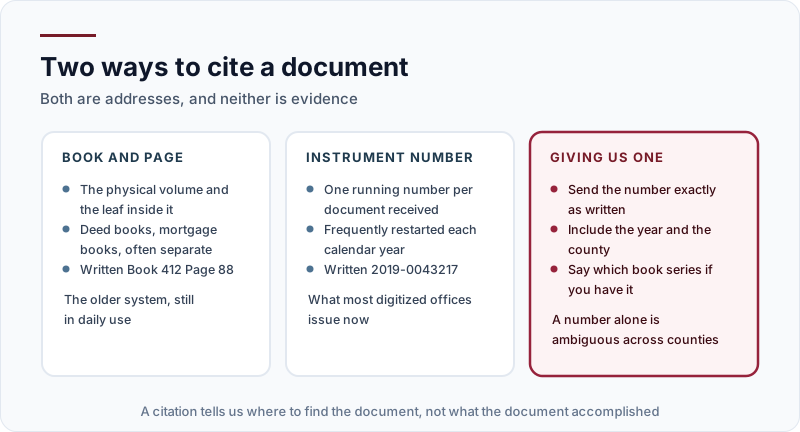
The older system is book and page. Documents were copied into bound volumes, often in separate series for deeds and for mortgages, and a reference like Book 412 Page 88 names the volume and the leaf. It is still in daily use in a great many offices.
The newer system is an instrument number or document number, one running number assigned to each document as it is received, very commonly restarted each calendar year. A reference written as 2019-0043217 is that kind.
Offices that have digitized usually issue instrument numbers going forward while keeping the book and page citations for everything already in the volumes, so a single chain can be cited both ways depending on the decade. That transition is part of what what happens when an office digitizes its records describes.
If you are sending us a reference, send it exactly as written, with the year and the county. A bare number is ambiguous, because the same number exists in several hundred offices.
The formatting matters more than it looks. Leading zeros are frequently significant, hyphens and slashes are not interchangeable between offices, and a book series letter dropped from the front of a citation can send a search into the wrong set of volumes entirely. Where the reference came off a printed report or a screen, the safest thing is to send the page it came from rather than retyping it.
What the recording date settles
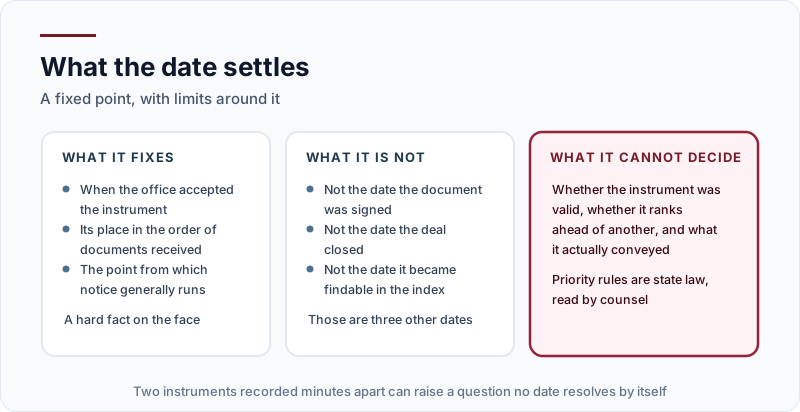
It fixes when the office accepted the instrument, and therefore its place in the order of documents received. That ordering is the foundation of how competing claims are sorted out, which is the problem taken up in what happens when two recorded documents claim the same land.
It is not the date the document was signed, which is usually earlier and sometimes much earlier. It is not the date a transaction closed. And it is not the date the document became findable, which comes later and is covered in what happens between signing a deed and finding it in the record.
It also does not decide the questions people most want decided. Whether an instrument was validly executed, whether it ranks ahead of another, and what it actually conveyed are matters of state law applied to the document, read by counsel. The record supplies the date. It does not supply the conclusion.
One document, several numbers
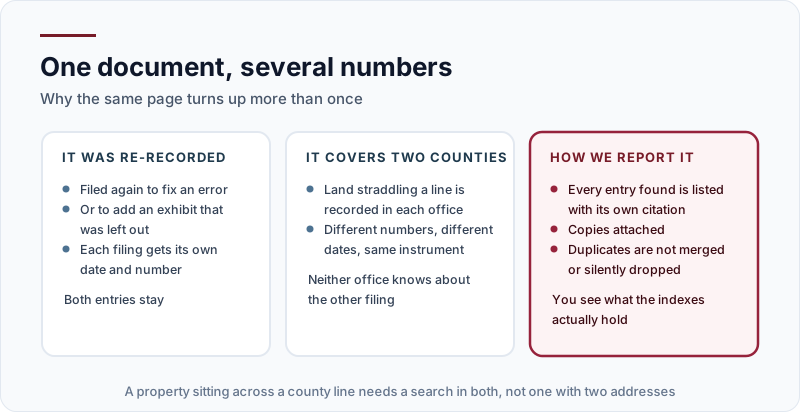
The same instrument can appear more than once. It may have been re-recorded to correct an error or to attach an exhibit left out of the first filing, and each filing takes its own date and number while both entries remain. That is one of the routes described in how a correction gets into the record.
It may also cover land in two counties, in which case it is recorded in each, with different numbers and often different dates. Neither office knows about the other filing.
We list every entry found with its own citation and attach the copies. Duplicates are not merged or quietly dropped, because the fact that an instrument was filed twice is frequently the interesting part. A chain that shows the same deed recorded in March and again in September usually has a story behind it worth asking about.
The takeaway
A citation tells an abstractor where a document is held. A recording date tells you when the office received it. Neither establishes that the document was valid, where it ranks, or what it conveyed, and the practice governing both is set county by county. Find the property that runs your search, or send us the citation and the county and we will tell you what can be retrieved before anything is ordered.