

· AFX Research, LLC
What a Search Finds When Land Has Not Been Sold in Decades
A parcel held by one family since 1952 produces a very short chain and a very long name search, and the quiet record is the thing most likely to be misread.
Table of Contents
Most searches assume a property has changed hands in living memory. A good many have not. Family farms, inherited houses, church land and parcels bought by a grandparent and never sold since are ordinary, and they behave differently enough that it is worth saying how.
A thin chain is not a clean one
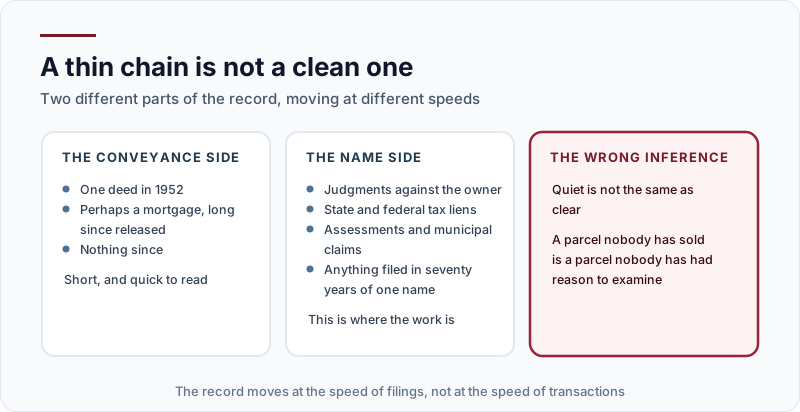
The conveyance side of the record is genuinely short. One deed in 1952, perhaps a mortgage long since released, and nothing after it. That part reads quickly.
The name side is where the work is. Everything that attaches by name rather than by parcel has had seventy years to arrive, so judgments, state and federal tax liens, assessments and municipal claims all have to be searched across a long period against whoever has held the land. That distinction is the one set out in name searches and parcel searches, and on quiet land it inverts the usual proportions.
The inference to resist is that a quiet record is a clear one. A parcel nobody has sold is a parcel nobody has had a reason to examine, which means nobody has had a reason to fix anything either. The general version of this is in what it means when a search finds nothing.
What seventy years accumulates
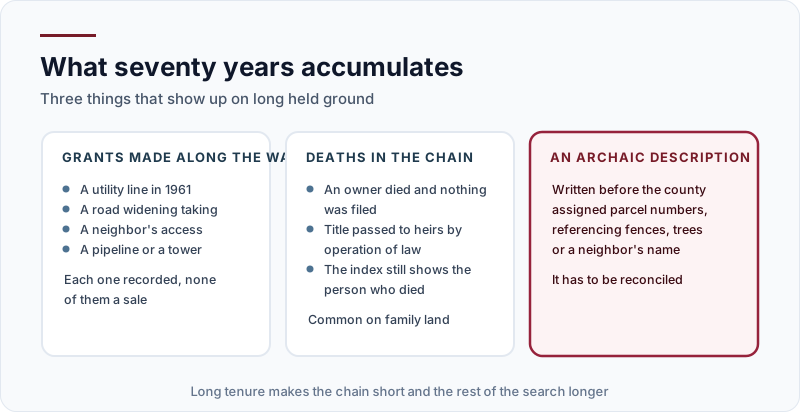
Three things show up repeatedly.
The first is grants made along the way. A utility easement in 1961, a strip taken for a road widening, a neighbor’s access, a pipeline or a tower lease. Each one is recorded, none of them is a sale, and together they can have changed the parcel considerably without the ownership moving at all.
The second is deaths in the chain. An owner died, nothing was filed, and title passed to heirs by operation of law while the index continued to show the person who died. That is extremely common on family land, and it is the mechanism described in how property changes hands without a deed.
The third is the description. A deed written before the county assigned parcel numbers may describe the land by reference to a fence, a watercourse, a tree or a neighbor’s name, and reconciling it against the modern parcel is part of the job rather than an afterthought. Our note on how land is identified in the record covers how those systems differ.
Why the owner may not be who the index says
This is the single most consequential feature of quiet land, and it is worth separating from the rest.
Where an owner died and no estate was opened, the county index keeps naming them. Nothing is wrong with the index. It records instruments, and no instrument was filed. The people who actually hold the property are the heirs, identified by a statute rather than by a document, and establishing who they are means going to a different office and frequently to several of them.
A search will report exactly this situation when it finds it, and reporting it is the useful outcome. What a search cannot do is decide who the heirs are, which is a legal question answered on evidence rather than a finding drawn from an index.
How far back to go
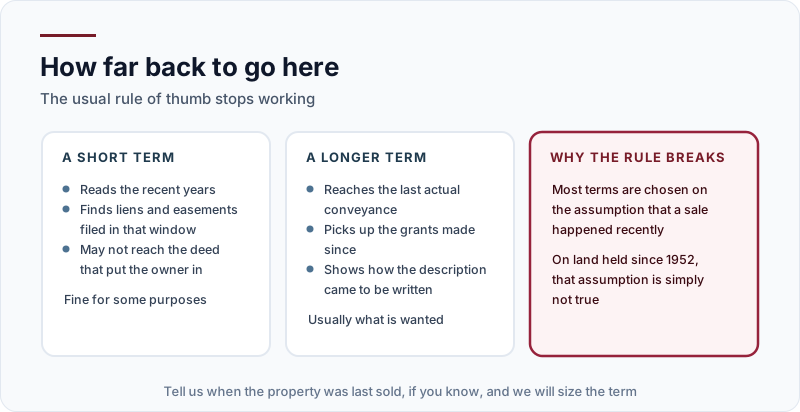
This is where the ordinary rule of thumb stops working, because most search terms are chosen on the assumption that something was conveyed recently.
A short term reads the recent years and finds what was filed in that window. On land held since 1952 it will not reach the deed that put the current owner in, which means it cannot show you how they came to own it or what the description was based on.
A longer term reaches the last actual conveyance, picks up everything granted since, and explains the description. That is usually what somebody actually wants, and the trade-off is the one discussed in how far back a search should go.
The practical fix is simple. Tell us when the property was last sold, if anyone knows, and the term gets sized to the property rather than to a default.
The takeaway
Long tenure makes the chain short and the rest of the search longer, and a record with little in it is a statement about filing activity rather than about the state of the title. A report describes what had been recorded and indexed in that county as of its effective date, and nothing more than that. Find the property that runs your search, or tell us roughly when the land last changed hands and we will point you at the right one before anything is ordered.