

· AFX Research, LLC
What Changes in a Search When a Government Owns the Land
Public land is acquired differently, sometimes never conveyed at all, and governed by rules the index does not mention. Why a thin result is often the correct one.
Table of Contents
Somebody runs a search on a parcel that turns out to belong to a city, a school district or a state agency, and the result comes back looking sparse. A deed or two, no mortgage, no chain worth the name. The instinct is that something was missed. Usually nothing was, because public land arrives in public hands by routes the land records were not designed to narrate, and a great deal of what governs it sits in files the recorder has never seen. It is a sharper version of what the recorder does not hold.
Public land sits in its own system
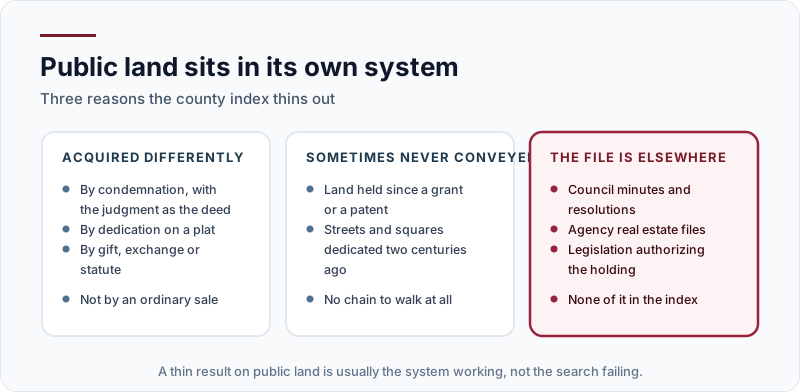
Start with how it was acquired. Condemnation, where the judgment functions as the conveyance. Dedication on a subdivision plat, where a developer hands over the streets. Gift, exchange, or an act of a legislature. None of those looks like an ordinary purchase and some of them leave very little in the grantor and grantee books. A condemnation in particular may be indexed under a case caption rather than in a form a parcel search would surface.
Some public land was never conveyed at all. Ground held since an original grant or patent, or a town square dedicated two hundred years ago, has no chain to walk because nobody ever bought it from anybody. The absence of a conveyance is the whole history, and reporting that honestly is more useful than searching harder.
And the governing paperwork is somewhere else. Council minutes, resolutions, agency real estate files, and the legislation authorizing the holding in the first place. All of it is public, and none of it is in the land index, which is why a search can be complete and still feel thin.
What is different about the rules
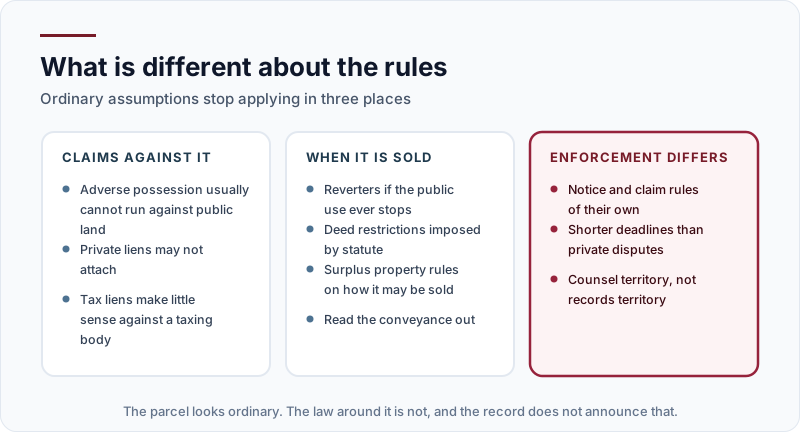
Several assumptions people carry into a search stop applying. Adverse possession generally cannot run against public land, so decades of a neighbor’s fence sitting across the line mean something different here. Private liens frequently cannot attach, and a tax lien against a taxing body makes little sense to begin with.
The more practical change comes when public land is sold. Conveyances out commonly carry reverters if a public use ever stops, deed restrictions imposed by statute rather than negotiated, and surplus property rules governing how the sale had to happen at all. Those are recorded, and they are the part a private buyer actually has to live with, in the way the restrictions in what is restricted in the public record are.
Enforcement differs too, with notice and claim requirements and deadlines shorter than private disputes carry. That is counsel’s territory rather than a records finding, and it is worth knowing that it exists before somebody assumes an ordinary limitation period applies.
How to ask for it
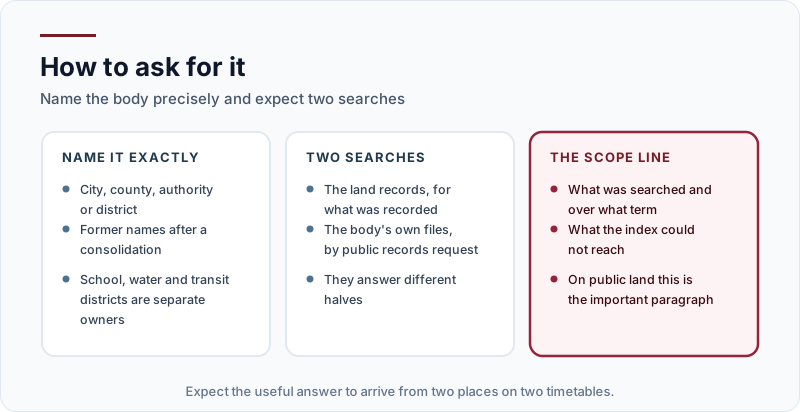
Name the body exactly. City, county, authority, or district, plus any former name after a consolidation. School, water, transit and library districts are separate owners with separate holdings, and the index sorts on what it was given, which is the point made in what an index is.
Expect two searches. The land records for what was recorded, and the body’s own files through a public records request for the resolutions, minutes and agreements. They answer different halves and run on different timetables, and the records request is usually the slower of the two, so start it first.
Then read the scope line, which matters more here than almost anywhere. What was searched, over what term, and what the index could not reach. On public land that paragraph is most of the value of the report.
The takeaway
Treat a sparse result on government land as information rather than as a failure. Name the owning body precisely, run the land records and a public records request in parallel, and expect the restrictions that matter to appear on the way out rather than on the way in. Find the property that runs your search, or tell us what you are trying to establish and we will point you at the right one before anything is ordered.