

· AFX Research, LLC
What Happens When a Document Is Recorded in the Wrong County
A deed or a lien filed in the wrong office is recorded somewhere nobody searching the land will look, how it happens, and why the repair is easy while the date is not.
Table of Contents
Recording a document is a local act. An instrument affecting land belongs in the office that keeps the records for the county where the land sits, and filing it anywhere else produces a document that exists, has a stamp on it, and gives notice to nobody. It is a quiet failure, and it shows up in chains more often than people expect.
Where a filing has effect
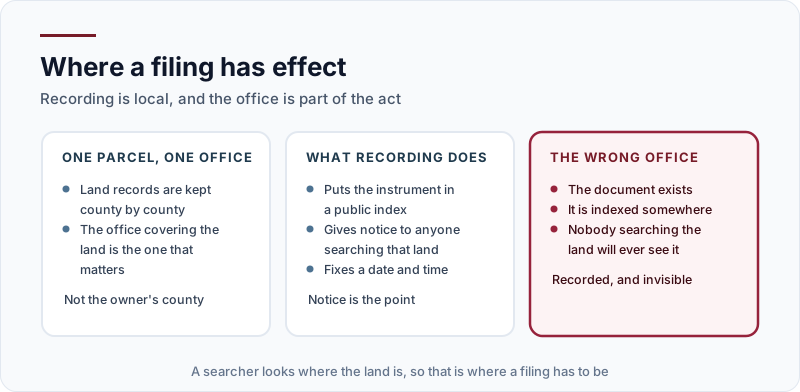
The purpose of recording is notice. Putting a deed or a mortgage into the public index means that anyone who searches that parcel will find it, and that is the entire mechanism, as how a document becomes a public record sets out.
Notice only works if the searcher is looking in the right place, and a searcher looks where the land is. A document filed in the county where the buyer lives, or where the closing happened, is indexed in a book that nobody researching that parcel will ever open. The office accepted it, stamped it, and gave it a number. None of that helps.
How it happens
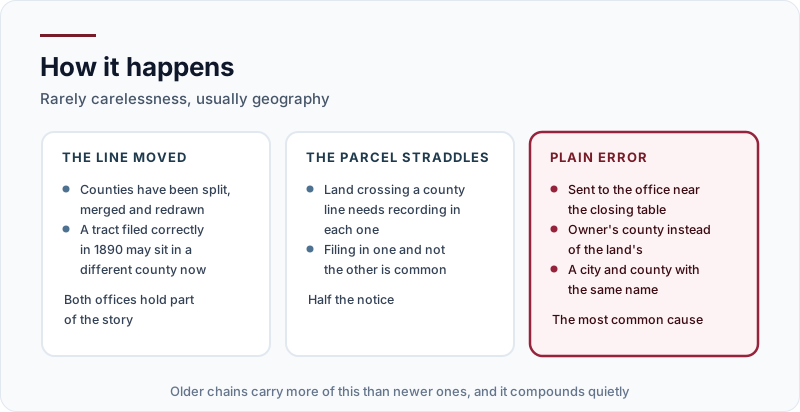
Carelessness is the least interesting cause. Geography does most of the work.
County boundaries have moved a great deal. Counties were split, merged and redrawn throughout the nineteenth and twentieth centuries, and a tract recorded perfectly correctly in 1890 may sit in a different county today, with the older part of its chain still held by the original office. That is a filing problem only in hindsight, and our note on what happens when a jurisdiction changes covers the research consequences.
A parcel that straddles a line needs recording in both counties, and filing in one of them is a common half measure, which is why when a property sits across a county line treats it as two searches rather than one.
Then there is plain error. Documents get sent to the office nearest the closing table, or to the owner’s county rather than the land’s, and in a handful of states a city and a county share a name while keeping separate offices.
Mailed filings add their own version. A package sent to the wrong office is sometimes recorded there rather than returned, because the clerk’s job is to accept a conforming document and collect the fee, not to check that the land described is inside the county. The stamp comes back, the file is closed, and nobody looks again for years.
What repairs it, and what does not
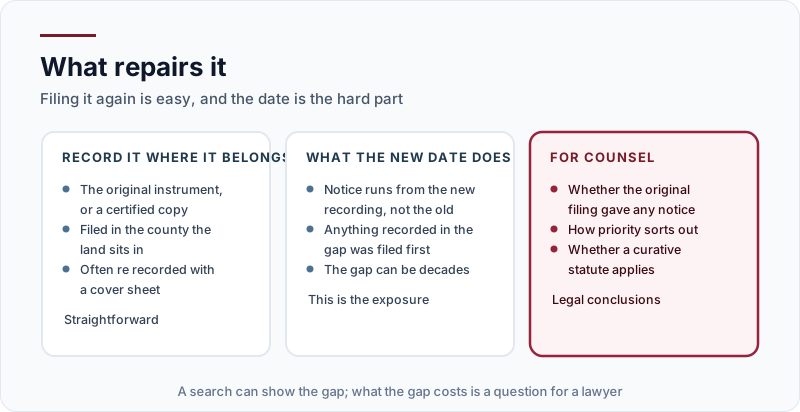
The fix itself is undramatic. The original instrument, or a certified copy of it, is recorded again in the county the land sits in, frequently with a cover sheet explaining the re-recording. Most offices handle this routinely.
What cannot be repaired is the gap. Notice generally runs from the new recording date rather than the old one, and anything recorded against that parcel in the intervening period was, as far as the index is concerned, filed first. Where the gap is a week that is a nuisance. Where it is thirty years, a great deal can have happened inside it.
Whether the original filing gave any notice at all, how priority sorts out, and whether a curative statute helps are legal questions that depend on the state. A records search can show the gap precisely. It cannot say what the gap costs.
The practical tell is a document that refers to something the index does not contain. A release naming a mortgage that was never recorded locally, a deed reciting a prior conveyance with no counterpart in the chain, or an assignment of a lien that has no original are all worth treating as a filing that landed elsewhere rather than as a document that does not exist, which is the reading what happens when the public record is wrong argues for generally.
The takeaway
Recording practice is local, which is the theme running through why recording practice is local, and this is one of its sharper edges. A search reports what was recorded and indexed in the county searched, over the term searched. If an instrument sits in a neighboring county’s book, a correct and thorough search of the right county will not find it, and that is a limit of the system rather than of the search. Where the history suggests a boundary moved or a parcel straddles a line, the answer is to search both offices. Find the property that runs your search, or tell us what you are trying to establish and we will point you at the right one before anything is ordered.