

· AFX Research, LLC
Why a Search Says Nothing About What a Property Is Worth
The numbers in a deed are drafting conventions and the assessed value is a tax figure. What a records search contributes to value, and which document answers the question.
Table of Contents
A reasonable request arrives most weeks. Somebody wants a title search and, while we are in there, an idea of what the property is worth. It is a fair thing to ask and the answer is that one document cannot carry both, for a reason that is more interesting than a disclaimer. The record was not built to hold prices, and the numbers that do appear in it mean something other than what they look like. The division is the same one set out in which professional answers which question.
Three questions, three documents
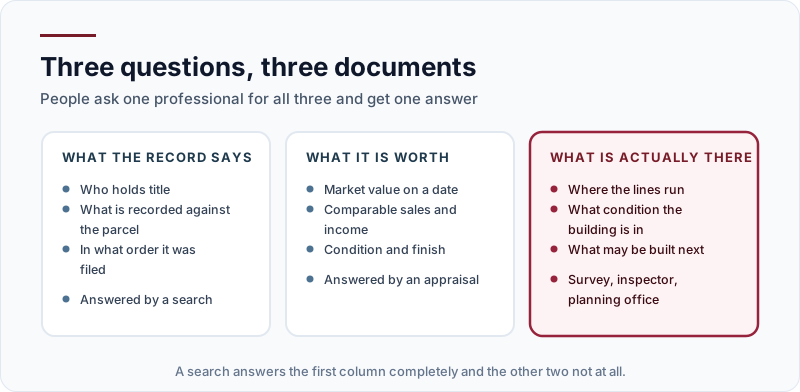
The first question is what the record says. Who holds title, what has been recorded against the parcel, and in what order. That is a search, and a search answers it completely.
The second is what the property is worth on a given date, which is an appraisal built on comparable sales, income, condition and finish.
The third is what is physically there. Where the lines run, what state the building is in, and what could be built next. That is a surveyor, an inspector and the planning office, in that order.
People ask one professional for all three because from outside they look like one question about a property. They are three, and the honest version of a report says which one it answered. Reports that blur the line are the ones that cause trouble later, because a reader who thought they had bought all three acts as though they did.
Why the record is silent on price
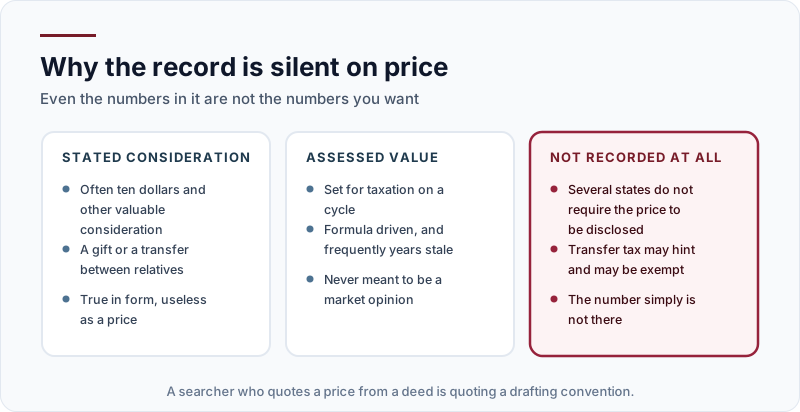
Deeds do carry numbers, and they are the wrong numbers. Stated consideration is frequently ten dollars and other valuable consideration, a drafting convention that is true in form and useless as a price, and on gifts or transfers between relatives it is nominal because the transfer was.
Assessed value is a different trap, because it looks authoritative. It is set for taxation on a cycle, by formula, frequently years out of date, and was never meant as a market opinion. It is a tax base. In some jurisdictions it is deliberately set at a fraction of market value, so even reading it as a floor is unsafe without knowing the local ratio.
And in several states the price is simply not disclosed. There is no requirement to record what was paid. Transfer tax stamps can hint at it where they exist, and plenty of transfers are exempt from the tax, so even that hint is unreliable. A searcher quoting a price from a deed in one of those states is quoting something that was never there, which fits the broader point in what the public record cannot be used for.
What the search does contribute
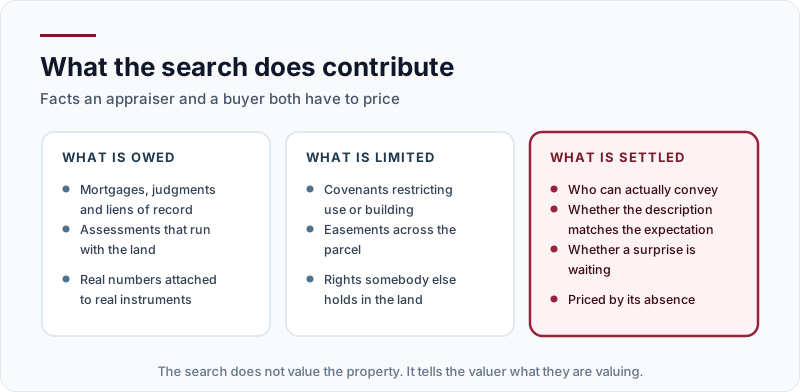
It establishes what is owed. Mortgages, judgments and liens of record, assessments that run with the land, each one a real number attached to a real instrument that somebody has to clear or assume. Those figures are not an opinion of value and they do bear directly on what a buyer can pay.
It establishes what is limited. Covenants restricting use or building, easements crossing the parcel, rights somebody else holds in the land. An appraiser valuing a parcel without knowing a pipeline easement runs through the buildable part is valuing a different parcel.
And it removes uncertainty, which is itself worth money. Who can actually convey, whether the description matches what everyone thinks they are buying, and whether a surprise is waiting. That last one is priced by its absence, which is why the work usually happens before a number is agreed rather than after. Our note on what happens after you order a search covers where it lands in the sequence.
The takeaway
Ask the search what the record says, and ask an appraiser what the property is worth. Give the appraiser the search, because the encumbrances and restrictions it finds are inputs they need and cannot generate. Find the property that runs your search, or tell us what you are trying to establish and we will point you at the right one before anything is ordered.