

· AFX Research, LLC
Why the Same Claim Gets Filed in More Than One Public Office
Creating a claim and attaching it to land are two separate acts filed in two separate systems, which is why a judgment can exist without yet touching a property.
Table of Contents
People are often surprised that a judgment against somebody can be perfectly real and not show up in a property search. The explanation is structural rather than accidental. Creating a claim and attaching it to a particular piece of land are two different acts, performed in two different offices, and only one of them is a land record.
One claim, two filings
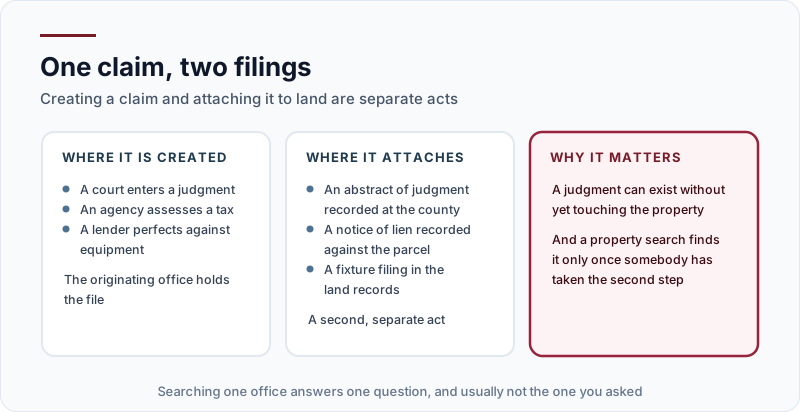
A court enters a judgment. That exists in the court file, with a case number, and it is enforceable as a judgment from that moment.
Attaching it to real property is a second step. In most states somebody has to record an abstract of that judgment, or a certified copy of it, in the county where the land sits. Until that happens the judgment is real and the parcel is unaffected by it, and a search of the land records correctly reports nothing.
The same shape repeats across other kinds of claim. An agency assesses a tax and then records a notice of lien. A lender perfects a security interest in equipment at the state and then, where the equipment is affixed to a building, records a fixture filing at the county. In each case the originating office holds the file and a separate act puts it on the land.
That two-step is also why the same property can look different depending on the day, which is the timing problem covered in what happens between signing a deed and finding it in the record.
Where the pairs show up
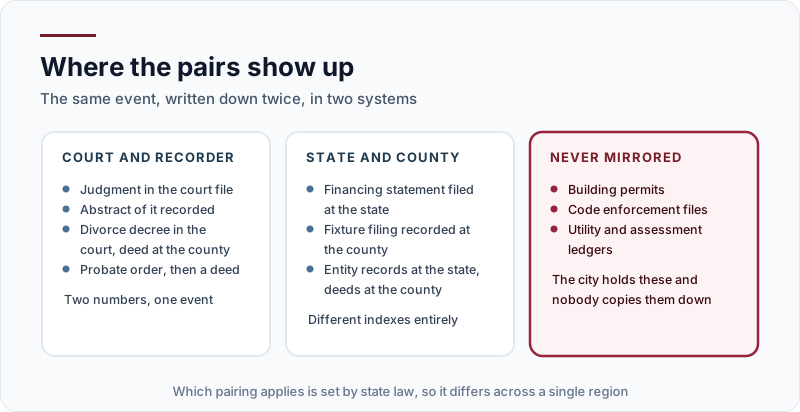
The court and the recorder are the most common pairing. A judgment and its abstract, a divorce decree and the deed that carries out the property division, a probate order and the deed that follows from it. One event, written down twice, in two systems with two numbers.
The state and the county make the second pairing. Financing statements are filed at the state, fixture filings at the county. Entity formation and name history sit at the state, deeds at the county. The indexes are entirely separate and neither one knows about the other, which matters whenever an owner is a company rather than a person, as what a search does when the owner is an entity sets out.
Then there is a third category with no pairing at all. Building permits, code enforcement files and utility and assessment ledgers are held by a municipality, and nobody copies them into the county record. Those are part of what what the recorder does not hold describes.
Which pairing applies, and what step is required to attach a claim to land, is set by state law. It differs across a single region, which is the general point made in why recording practice is local.
What this means for an order
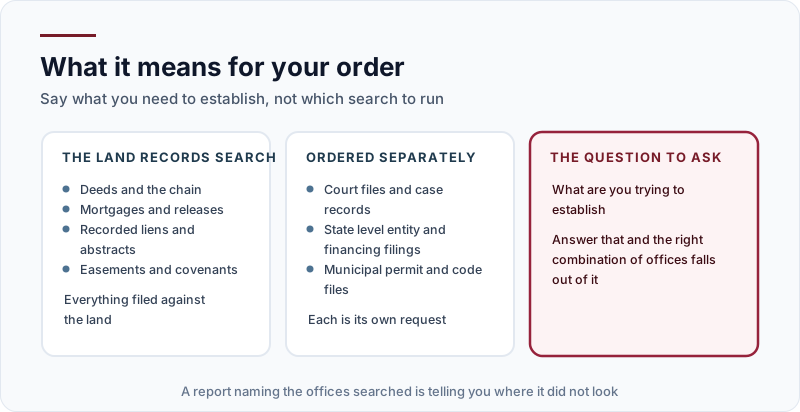
A land records search covers what has been filed against the land. The chain, the mortgages and releases, recorded liens and abstracts, easements and covenants. That is a complete answer to a specific question.
Court files, state level filings and municipal records are separate requests. None of them is harder to obtain, and none of them is included by default, because including everything by default would mean pricing every search as though it were all of them.
The useful habit is to say what you are trying to establish rather than which search to run. Whether a person owns anything, whether a lender can be paid off, whether a company has filings against it, whether a building was permitted. Each of those resolves to a different combination of offices, which is the routing question taken up in which title search do you need.
The takeaway
A report that names the offices it searched is also telling you where it did not look, and that is a feature rather than a limitation. A claim can exist in one system and be invisible in another without anything having gone wrong. Find the property that runs your search, or tell us what you are trying to establish and we will point you at the right one before anything is ordered.